On January 20th, Donald Trump took office and spurred a wave of unrest in progressive communities, including the writing community. My feeds were filled with panicking authors worrying about book bans, ditching social media owned by Trump’s lackeys, and sharing resources for marginalized communities like undocumented immigrants and trans people.
I’m not going to lie and say there’s no reason to worry. There is. Much of Trump’s playbook is copied from Nazi Germany: a time of death and destruction for many of the most vulnerable people, including Jews, LGBTQ people, Roma people, the mentally ill or disabled, and political dissidents.
One only needs to see the Nazi salute heard ’round the world to know that fascism is well and truly here in the United States – and it’s creeping up in other countries, too.
Nazi Germany, too, was a time of extreme censorship. Mass book burnings took place at 34 different university towns before hundreds of libraries and book stores were raided for material that was “un-German.” Several authors, including Carl von Ossietzky and Erich Mühsam, were taken to concentration camps. Both these men were tortured, and Mühsam was shot to death by an SS commando in the middle of the night.
And, of course, thousands of gay men and transgender people were placed in concentration camps and killed. These individuals are often forgotten as victims of the Holocaust, but they are the reason that the pink triangle is a sign of resistance against authoritarian, anti-LGBTQ governments. They deserve just as much honor as the Jewish, Roma, disabled, and political dissident victims.
The world’s first trans clinic was destroyed by Nazi Germany, setting back the trans rights movement by decades. Thousands of priceless articles and research papers on LGBTQ identity were stolen and burned; the staff was beaten up. Magnus Hirschfield, the founder of the Institut für Sexualwissenschaft and a brave pioneer of trans research, escaped capture by being abroad at the time, and he had his citizenship revoked by the government. He could never return and rebuild his legacy.
While I would hope that the situation here will never become so dire, one can’t really be sure.
Even as a very small author with a miniscule platform, I do worry about censorship. My Eirenic Verses series revolves around LGBTQ relationships, including some spicy scenes. In today’s world, major platforms like Amazon (which is what I use) can censor millions of books with the click of a button – far more efficiently than Nazi Germany ever could.
Will they remove all LGBTQ books? They very well could. One only has to look at how Facebook is now allowing anti-LGBT hate speech, or TikTok censoring the words “Free Palestine,” to see how easy it is for these platforms to elevate hate and crush dissent.
And this is to say nothing about the government itself. Other anti-LGBTQ governments have already made examples of authors who write about queer relationships. Numerous authors were recently arrested in China for writing gay erotica, and one received 10 years in prison back in 2018 for the same thing.
I don’t say this to scare anyone. I think it’s important to balance realism with optimism: to see our situation clearly and form a plan of attack. We can’t understand what we’re fighting against unless we understand the historical precedent and the tactics that were previously successful in defeating censorship.
We should never lose hope or stop writing.
In fact, our writing is more important than ever. We have a moral responsibility to continue resisting, making art that challenges worldviews and forces people to think for themselves.
And, for us LGBTQ authors, we are responsible for documenting what’s happening so future generations can understand how this happened – and avoid falling into the same traps.
If you write politically charged works, your writing is even more important than mine. You are the one who will document this history, in whatever way you choose to, and hold the memory as a warning for others. We are relying on you to tell our stories.
The thing is that fascism does not last long. Nowhere near as long as books. Book bans and censorship are temporary, but books are forever.
Just look at Oscar Wilde. He was sent to prison for two years for sodomy, which was illegal and a massive taboo in his day. However, we still read his books long after his death. The Importance of Being Earnest is hilarious over a century later, and I’m sure it will remain so for many centuries to come.
Sappho, essentially the birthmother of the WLW community, wasn’t necessarily in the gay utopia that we think of when considering ancient Greece. Women were not seen as equals, and the love between women wasn’t celebrated. Even in her surviving fragments of poetry, Sappho writes of forced marriages and forbidden relationships: not at all what we think of when imagining this accepting paradise.
But yet both these authors are still remembered – more so than those who persecuted them. Books are enduring. They will continue to thrive long after tyrants fall and empires are toppled.
This gives me significant comfort when I think about the years ahead. When I imagine the longevity of authors like Shakespeare (who also lived in a politically repressed time), I know that work from this era will continue to be read and loved long after we are gone.
We must build our community stronger than ever.
The LGBTQ community has become a bit complacent in recent years. We’ve turned solipsistic, more focused on naming our exact identities and fighting about who has it worse.
Many seem to have forgotten that being LGBTQ is not just about drag parties, parades, and theme nights: it is a political identity as long as we do not have equal rights.
The community itself is not about picking the exact label out of hundreds that you think best fit your specific blend of sexuality and romance. It’s not about coming up with a brand new gender identity and pronoun set that only you own, like a gender NFT. It’s not about your sex life or lack thereof, and these should not be the primary discussions we all have.
You’re free to do those things if you want, and I can’t stop you. But ultimately, that’s not really what being part of the LGBTQ community is about. That’s you exploring your own identity, not about us as a whole. You can do those things privately, either in your own mind or with trusted friends, rather than centering these labels as “the” LGBTQ discourse.
Rather, the LGBTQ community is about standing together against fascism and ensuring that we’re not going to be herded into concentration camps again.
We are not wholly to blame, though. the AIDS pandemic ravaged an entire generation of LGBTQ people and made it hard to rebuild our community. Without a large group of queer elders to pass on their lived experiences, and without a strong push to educate every generation about what we have been through, it’s easy to forget that being LGBTQ is not just a cute label or a passcode to exclusive parties.
But our enemies never forgot. They have always hated us and always will.
Which is exactly why we need to reject infighting and stop tearing our own community apart, tenderizing ourselves for those who want to take away all our rights.
The “LGB without the T” movement is the most egregious example of the community turning on itself in hopes that by throwing trans people under the bus, the rest of us will be spared. It’s laughable to think that conservatives and fascists will stop with just trans people, though. By rejecting one member of the community, you are dooming the rest of us, too.
We need to stand together. Most importantly, I will always stand with my trans siblings, who have been there right beside us from the very beginnings of the LGBTQ movement in the United States. They are an indispensible, precious part of our community, and I will never forsake them.
Let me make it clear. If you face being stripped of your rights or tortured for your gender identity or sexuality, you are LGBTQ.
If your legal right to marry, to own property, to give blood, to have your proper gender identity label on paperwork, to use the bathroom, or to receive affirming treatment has ever been a political agenda due to your gender identity or sexuality, then you are LGBTQ.
Of course, I don’t want those things to happen, but they do, here and around the world. That is what makes the LGBTQ community a community – a movement against fascism and political extremism.
If you are LGBTQ, you are a political being.
Your very identity is a political statement, whether you like it or not. You are anointed in blood from the many gay, lesbian, bisexual, and trans people who were tortured and killed before. You were born with a brick in your hand, ready to throw.
So where do we go from here?
Simple. Keep writing. Find alternative methods of distribution if you are censored on major platforms, whether that’s an ebook platform abroad or hosting everything on your own website. Our allies in other countries will be indispensible here, and I hope they will help.
For the community as a whole, stop navel-gazing. Stop fussing and virtue signalling. Stop prioritizing your personal feelings over solidarity. Stop infighting. Stop shoving other LGBTQ people under the bus.
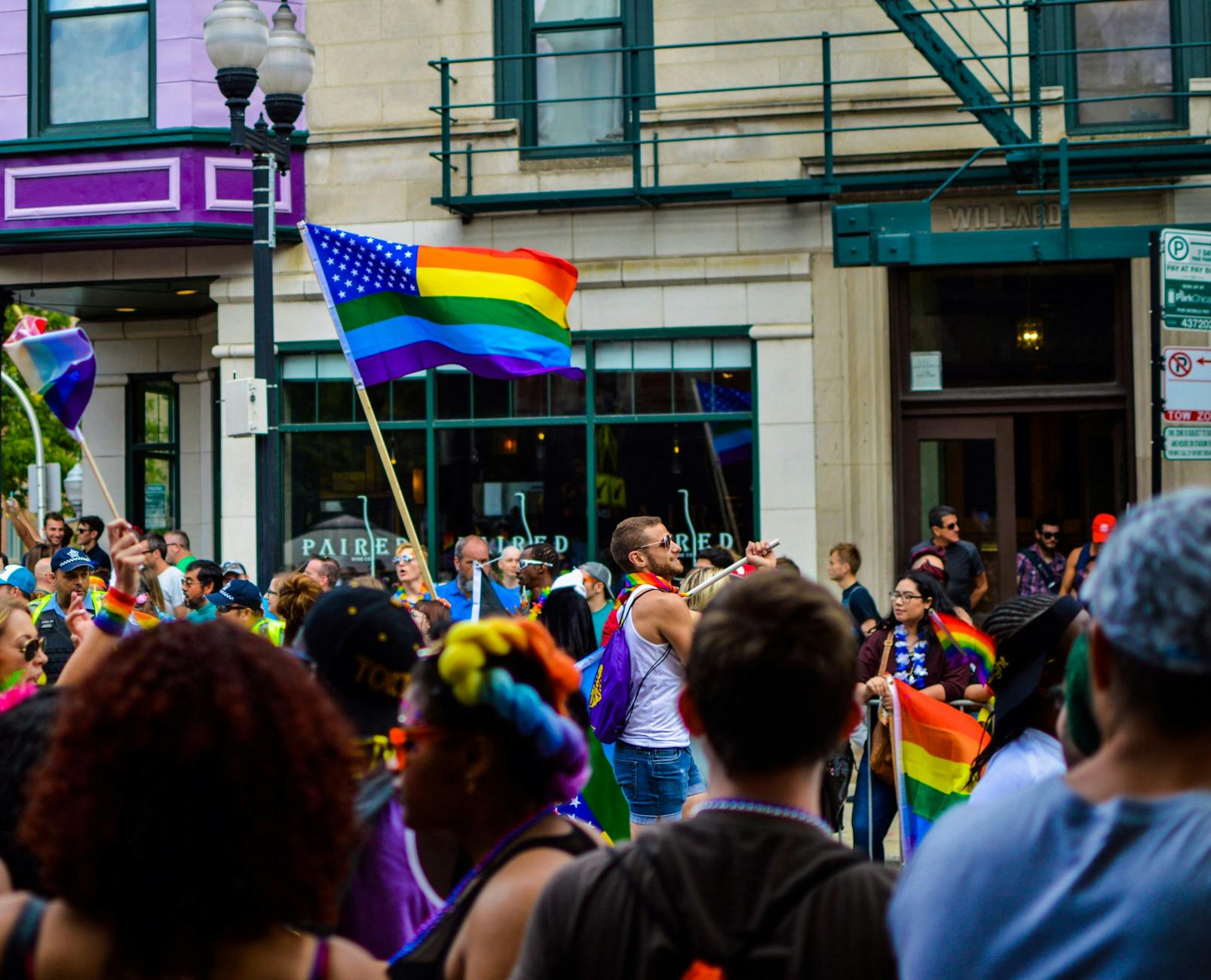
Remember that LGBTQ is a political movement, no matter how much Rainbow Capitalism has tried to brainwash us into thinking otherwise. The Pride Parade did not start as a party, but a clear reminder to those in power that we exist – we have always existed – and we will not stop existing, no matter how much they try to legislate or torture out of existence.
We are fighting for our rights, for equality. We are in danger; we have always been in danger, no matter how much people have tried to lull us into a false sense of security.
And the pen is, and will always be, mightier than the sword. Never forget that. Keep working. Keep speaking out. Keep telling your stories.
We have always outlasted our enemies, and we always will. Thousands of years on, repression after repression, and we are still here. They cannot get rid of all of us.
Times will be hard; people will suffer. But LGBTQ people will always exist. And we, as people living in an era of repression, have a responsibility to pave the way for those who will come next. To warn them against complacency and to ensure they never suffer as we have.
We are here. We are queer. We won’t disappear.
Carry that promise in your heart for the many dark days to come.